The New Political Order and the Digital Era
11–12 June 2026 Poznan - Ciążeń
The Council for Research in Values and Philosophy in Washington D.C.
Department of Political Philosophy and Social Communication at the Faculty of Philosophy,
Adam Mickiewicz University in Poznań
Department of Science, Technology and Society Studies
at Wrocław University of Science and Technology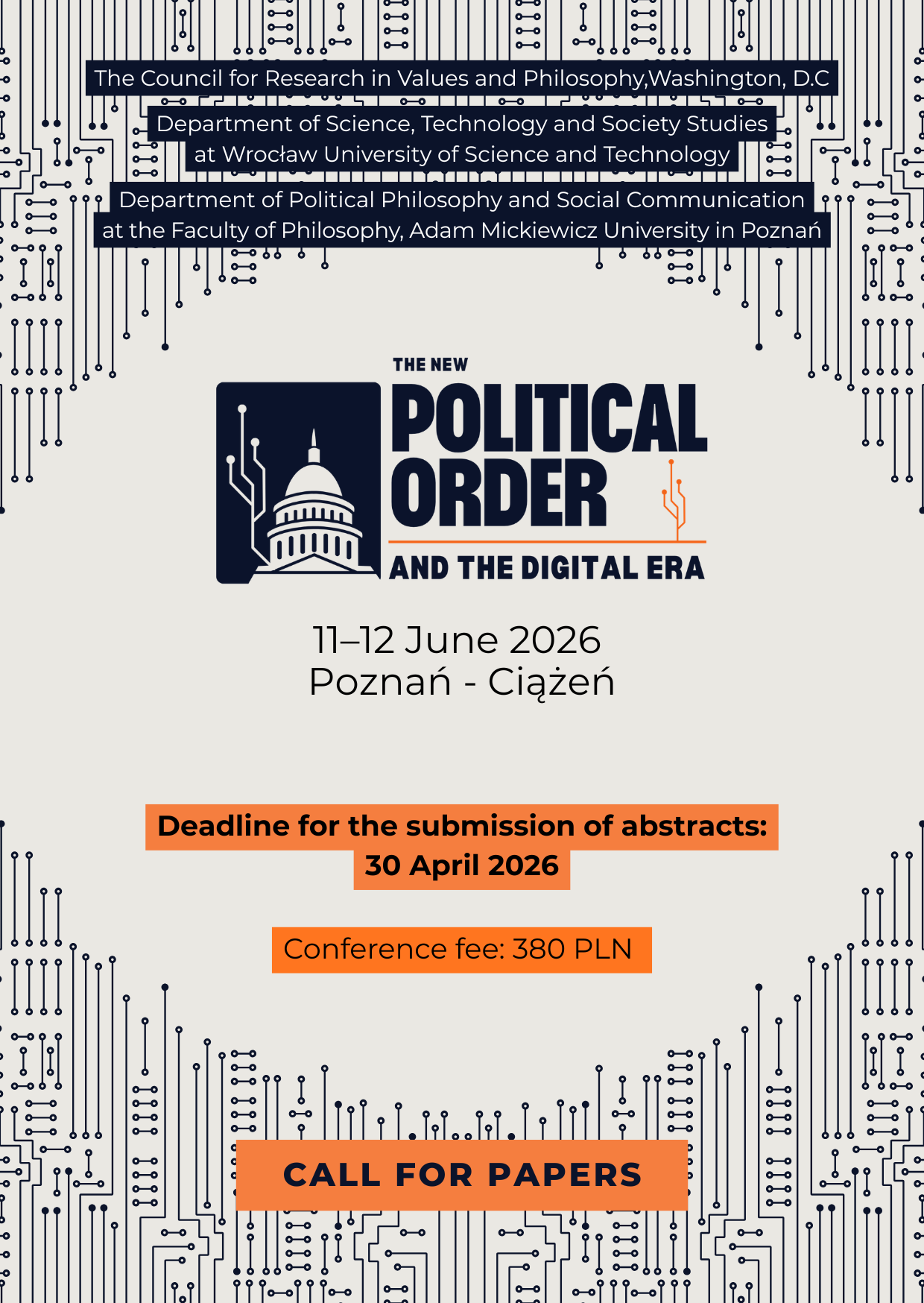
Contemporary societies are undergoing a profound transformation of the political order, with digital technologies serving as a key driving force. The algorithmization of decision-making processes, the platformization of public communication, and the growing role of data in social governance are generating fundamental changes in the exercise of power, the functioning of democracy, and the understanding of political subjectivity. These developments exceed the explanatory scope of classical political theories and call for new analytical categories as well as critical normative reflection.
This transformation unfolds amid intensifying geopolitical competition over digital infrastructure, artificial intelligence, and control over data flows, leading to the emergence of new forms of digital sovereignty and a redefinition of the relationship between the state, the market, and global technology corporations. The development of artificial intelligence systems, including generative models, not only automates administrative and communicative processes but also reshapes the epistemic foundations of public life, influencing the production of knowledge, the status of truth, and the mechanisms through which political opinion is formed.
The aim of the conference “The New Political Order and the Digital Era” is to create an interdisciplinary forum for debate on the philosophical, political, and institutional consequences of digital transformation. The conference seeks to examine the relationship between technology, power, and democracy, with particular emphasis on algorithmic forms of governance, transformations of the public sphere, and emerging configurations of political responsibility.
The conference is organized by the Department of Political Philosophy and Social Communication at the Faculty of Philosophy, Adam Mickiewicz University in Poznań, in cooperation with the Department of Science, Technology and Society Studies at Wrocław University of Science and Technology, and The Council for Research in Values and Philosophy in Washington, D.C. The conference will be held in English.
Scholars representing political philosophy, democratic theory, philosophy of law, social sciences, technology studies, and related disciplines are invited to participate. The organizers welcome submissions of both theoretical and normative papers, as well as critical analyses of contemporary processes of the digitalization of political life. The conference is intended to serve as a forum for the exchange of ideas and for reflection on the future of the political order in the context of the dynamic development of digital technologies.
 Proposed Thematic Sections
1. Algorithmic Power and New Forms of Governance
This section is devoted to the analysis of transformations in political and administrative power under conditions of algorithmic decision-making. Its aim is to reflect on the role of computational systems, predictive models, and data infrastructures in shaping contemporary forms of governance. Particular emphasis will be placed on the shift from decisions grounded in legal procedures toward preventive and operational mechanisms.
The section will examine the relationships between technology, power, and political responsibility, as well as the redefinition of sovereignty under conditions of data-driven governance. A central concern will be the question of the legitimacy of decisions made by technical systems. The section also encompasses the analysis of the data economy and so-called surveillance capitalism, in which the commercial exploitation of behavioral data becomes the foundation for new forms of predictive social control.
2. Democracy, Participation, and the Public Sphere in the Digital Environment
This section focuses on the transformation of democracy and the public sphere in the context of digital communication technologies. Its aim is to analyze the impact of digital platforms, social media, and recommendation algorithms on processes of deliberation and political participation. Particular attention will be given to new forms of social mobilization and to structural changes in public debate. Phenomena such as polarization, fragmentation of public opinion, and disinformation will be critically examined. The section opens a space for reflection on the status of truth, trust, and authority in the digital public sphere. A key theme concerns the role of visibility and attention in political communication.
The section also includes analysis of the impact of generative technologies (including deepfakes and synthetic content) on the integrity of electoral processes, public deliberation, and social trust. Discussion may address the mechanisms of the attention economy, political microtargeting, and the role of platform architecture in shaping electoral behavior. An important contextual dimension is the problem of digital inequalities and asymmetries in access to communication infrastructure, which affect the quality and inclusiveness of democratic processes.
3. Political Subjectivity and Citizenship in the Digital Age
This section is devoted to reflection on the transformation of political subjectivity in the context of the digitalization of social life. Its aim is to analyze the impact of datafication, profiling, and automation on individual autonomy and agency. Particular attention will be given to the relationships between freedom, security, and control. New models of citizenship emerging within the digital environment will be examined, along with the redefinition of responsibility and political participation. A central theme concerns the tension between privacy and exposure.
The section may also include reflection on the biopolitical dimension of data collection and processing, in which the body, behavior, and emotions of individuals become components of informational infrastructures. An important issue is the development of digital identification systems and social scoring mechanisms, as well as their impact on the structure of citizens’ rights and obligations. Discussion may further address the consequences of automating intellectual and administrative labor for the status of citizenship, political participation, and the evolving relationship between human actors and decision-making systems.
4. Law, Regulation, and Responsibility in the Digital Political Order
This section addresses the legal and institutional challenges associated with the development of digital technologies. Its aim is to reflect on the capacity of law to regulate algorithmic decision-making systems. Particular emphasis will be placed on questions of accountability and transparency. The section will examine the relationship between state regulation and the power of technological actors, as well as the protection of fundamental rights within digitally mediated environments. A key theme concerns the tension between innovation and democratic oversight.
The section may include analysis of contemporary regulatory initiatives such as the AI Act, the Digital Services Act, and the Digital Markets Act, together with their philosophical and constitutional implications. An important issue is the problem of jurisdiction and the transnational character of digital platforms, which challenge classical models of legal responsibility.
5. Algorithmic Rationality and the Transformation of the Democratic Order
This section is devoted to the analysis of algorithmic rationality as an emergent dimension in the organization and exercise of political power. It seeks to examine how data infrastructures, predictive analytics, and machine-learning models increasingly structure public decision-making processes. Particular attention will be paid to the displacement of decision-making authority beyond classical democratic procedures and institutional frameworks.
The section will critically assess the implications of this shift for democratic legitimacy and political accountability. It addresses the complex relationship between technology, normativity, and decision, as well as the reconfiguration of the horizon of the political itself under conditions of data-driven governance.
Further discussion may explore the epistemological foundations of algorithmic rationality, including problems of data bias, model opacity (the “black box” problem), and the tension between efficiency, optimization, and justice. Contributions may also engage the thesis of a transition from procedural democracy toward technocratic or post-democratic forms of governance grounded in computational rationality and data-driven management.
6. Geopolitics of Technology and Digital Sovereignty
This section focuses on the geopolitical dimensions of digital transformation. It invites analysis of global technological competition, semiconductor policy, strategic control over supply chains, and the role of major technology corporations in international relations. Particular emphasis will be placed on the tension between the normative ideal of an open internet and its growing fragmentation (the so-called “splinternet”). The section may also address questions of infrastructural dependency, strategic autonomy, cybersecurity, and the evolving relationship between democratic political systems and authoritarian models of digital governance.
The conference will take place on 11–12 June 2026 at the UAM Creative Work Centre in Ciążeń.
Registration:
Deadline for submission of abstracts: 30 April 2026
Notification of acceptance: 15 May 2026
Conference fee payment deadline: 30 May 2026
Deadline for submission of accepted full papers for publication: 30 September 2026
Conference fee: 380 PLN (The fee covers conference materials, accommodation, catering, and publication costs for papers accepted for print.)
Participants are kindly requested to submit an abstract of 300–500 words, along with a short academic biography, in Microsoft Word or PDF format to the conference organizer. The final deadline for submissions is 30 April 2026.
For further information, please contact Dr. Lidia Godek-Ostrouch at: godly@amu.edu.pl